
2025 ASCE MLAB Project Awards

Civil Engineering is a vital component of what makes Los Angeles one of the best cities in the world. The American Society of Civil Engineers (ASCE) Metropolitan Los Angeles Branch (MLAB) is excited to honor these Projects for their significant impact to the Civil Engineering community and Los Angeles.
Outstanding Airport/Port Project
Congressman Alan Lowenthal Global Trade and Education Center
Port of Long Beach
The new Congressman Alan Lowenthal Global Trade and Education Center provides a venue to demonstrate the Port of Long Beach (POLB) benefits and leadership in sustainability, energy efficiency, and environmental design to business partners, stakeholders and community groups.
WSP led the design of the approximately 10,000 sf space which now includes an exhibit area, conference room, huddle room, kitchenette, hospitality and meeting areas, audiovisual equipment room and storage room. Anchored by a three-dimensional map table of the port, the space includes an LED video wall showing port operations, a timeline of key events at the port since it’s 1911 founding and displays of new technology and other innovations at the port which highlights the Port’s focus on community ties and becoming a “Green Port”.
An important and very complex part of the project included the constant coordination between WSP, POLB, Plenary and various subconsultants. The project essentially had two separate designs being conducted at the same time: Tenant Improvement and Exhibit Development. Weekly team meetings were held throughout the design and construction phases.
Another complex issue was that the project was constructed in the existing Port Administration Building which was fully operational at the time of construction. Therefore, certain tasks had to be scheduled during nights or weekends to avoid disruption to the normal building activities.
The project was delivered below the estimated budget, which is remarkable considering the cost of supplies and labor had increased significantly since the original project budget was proposed. POLB held a successful grand opening ceremony at the Center on May 16, 2024, and POLB is looking forward to many more events to showcase the POLB’s focus on community ties.

Outstanding Architectural Engineering Project
Diversity Plaza Creekside Park Improvements
City of Walnut/RKA Consulting Group
Completed in Spring 2024, the Diversity Plaza Project transformed an underutilized portion of Creekside Park into a vibrant, inclusive public space for the Walnut community. The project introduced a splash pad, shade structures, decorative seating, picnic areas, drought-tolerant landscaping, and a custom mosaic art installation celebrating community diversity. The project also incorporated a stormwater biofiltration system funded in part by Measure W, supporting sustainability and water quality goals. Through creative design and inter-agency cooperation, the City of Walnut and RKA Consulting Group delivered a multi-functional space that promotes health, cultural expression, and environmental responsibility.

Outstanding Bikeways & Trails Project
El Segundo Boulevard Improvement Project
City of El Segundo
The El Segundo Boulevard Improvement Project was an $8M transformative, regional infrastructure initiative dedicated to enhancing safety and mobility along 1.5 miles of El Segundo Boulevard from Illinois Street to Isis Avenue, rehabilitating pavement, upgrading traffic signals, installing drought-tolerant landscaping, and installing corridor-wide bikeways. The project also constructed another 2.5 miles of bikeways along 3 other streets, creating a multimodal network that connects businesses, schools, and Metro light-rail stations in the City of El Segundo.

Outstanding Bridge Project Outstanding
Pier 400 On-Dock Rail Expansion
Port of Los Angeles
The Port of Los Angeles, the busiest seaport in the Western Hemisphere, is recognized around the world for its leadership and innovative approaches to cargo transport and efficiency, state-of-the-art infrastructure and digital technology solutions. The $73 million Pier 400 On-Dock Rail Expansion project is an innovative project completed in June 2024. This multi-year, major infrastructure improvement upgraded and expanded the intermodal rail storage yard near the Port’s container terminal, greatly improved cargo flow, reduced emissions, and boosted overall safety in the Port.

Outstanding Community Improvement Project
Davenport Park – Expansion & Landfill Gas Control Project
City of Long Beach
The Davenport Park Expansion and Landfill Gas Control System Project is a comprehensive initiative by the City of Long Beach to transform a former landfill site into a safe, accessible, and vibrant community park. This project consists of two interconnected components: the Park Expansion and the Landfill Gas (LFG) Control System.
The Park Expansion component includes the development of new recreational amenities such as a sports field, fitness stations, outdoor seating areas, and expanded parking along E. 55th Way, Long Beach. These improvements aim to enhance community health, provide accessible outdoor spaces, and support adult and youth fitness through safe, well-designed infrastructure.
Equally critical is the LFG Control System, designed to address the environmental challenges associated with repurposing a former landfill site. Landfills naturally produce gas, primarily composed of methane and carbon dioxide, as organic waste decomposes underground. Methane is highly flammable and poses a serious health and safety risk if not properly managed. The gas can migrate through soil and accumulate in enclosed spaces, creating a potential explosion hazard.
To ensure the safety of park users and the surrounding community, the City implemented a robust landfill gas mitigation strategy. This includes the installation of an underground gas collection and control system, extraction wells, perimeter probes, and a permanent treatment system with noise-reduction features. The system continuously monitors and manages methane levels, preventing harmful emissions and ensuring compliance with local and state environmental regulations.
The importance of mitigating landfill gas cannot be overstated when converting a landfill to a public park. Without proper gas control, harmful emissions could endanger public health, damage infrastructure, and compromise the long-term viability of the site. By investing in a state-of-the-art mitigation system, the City of Long Beach demonstrates its commitment to sustainability, public safety, and responsible land reuse.
Together, these efforts transform Davenport Park into a model for environmentally responsible redevelopment—providing safe recreation today while protecting the health of future generations.

Outstanding Construction Project
Isomax Nitrogen Oxides Selective Catalytic Reduction F-720/731 Project
Chevron
The Chevron Isomax NOx (nitrogen oxides) SCR (Selective Catalytic Reduction) F720/731 Project aims to mitigate NOx emissions and concentrations in accordance with the revised Rules 1109.1 (Emissions of Oxides of Nitrogen from Petroleum Refineries and Related Operations) and 429 (Startup and Shutdown Provisions for Oxides of Nitrogen), as stipulated by the South Coast Air Quality Management District (SCAQMD). This project involves the introduction of ammonia, which is mixed with fuel gas, facilitating the conversion of NOx molecules into more benign substances such as nitrogen and water vapor upon passing through a selected catalyst. This installation resulted in the reduction of NOx from 71 to 4 metric tons per year.
The initiative encompasses the installation of a draw-through, down-flow SCR system and auxiliary equipment within a common plenum at the discharge points of the F-720 and F-731 furnaces. The new installations include an ID fan, ductwork, dampers, expansion joints, a common stack, ammonia control equipment, and associated instrumentation and control (I&C) systems. Furthermore, the electrical infrastructure has been upgraded to accommodate the new loads introduced by the SCR equipment.
This project necessitated extensive and intricate civil and structural construction work, which was successfully executed, mostly while the plant was in-service. The civil/structural construction phase involved the installation of 79 piles (ranging from 54’ to 60’ in length embedment and 24” to 30” in diameter), approximately 490 tons of steel work, 400 tons of concrete pours, 135 tons of ducting work, and the erection of a 180-foot tall, 13.5-foot OD stainless steel stack, with over 3000 feet of pipelines and a total 319 welds.
In addition to civil/structural work, the project included other disciplinary construction phases that were aligned with the civil/structural construction. These phases involved the installation of instruments, guillotine dampers, loop checks, SCR reactors, SCR catalysts, induced draft fans, induced draft fan drivers, induced draft fan louver dampeners, and more. The installation and assembly of these components required a large number of lifts using different sizes of cranes including an 1800-ton crane (TC-28000), operating at the same time within a limited area of the high-consequence plant.

Outstanding Emergency Response Project
Mulholland Drive Emergency Bulkheads (Sites 1-4)
City of Los Angeles, Bureau of Engineering
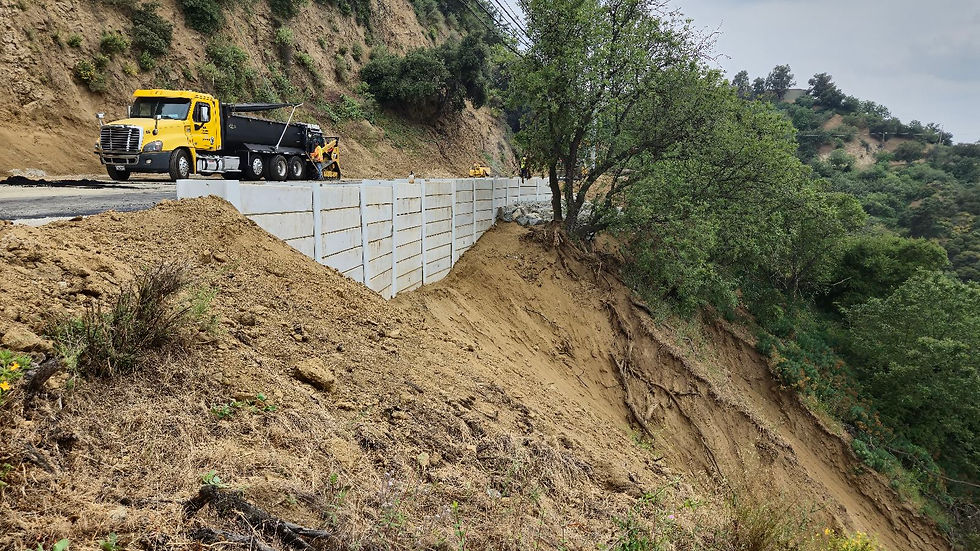
Due to extensive rains in early February 2024, four washouts occurred on Mulholland Drive, a major thoroughfare in the Hollywood Hills. The washouts necessitated a full closure of the highway over a nearly two-mile stretch of road, resulting in lengthy detours and disruptions. The City quickly designed repairs and mobilized two contractors, Jilk Heavy Construction, Inc. and Mike Prlich and Sons, Inc. to construct four bulkheads consisting of steel beams and pre-cast concrete lagging. The lengths of the bulkheads ranged from 24 feet to 100 feet, and varied from 8 to15 feet high. In total, over 278 linear feet of bulkhead were installed. The contractors also installed new asphalt concrete berm, a new drainage pipe and rockfill outlet, and repaired a catch basin and roadway pavement in the area to mitigate damage from future rainstorms. The roadway was reopened to traffic on May 25, 2024.
Outstanding Energy Project
Isomax Heat Integration and DEcarbonization (HIDE)
Chevron
Chevron's HIDE project reduces CO2 emissions, restores ISOMAX to its 1969 nameplate capacity, lowers energy use, and increases returns. The reduction in carbon emissions has been accomplished by optimizing unit heat integration and shifting steam generation to the more efficient cogeneration system. This involved replacing eight existing heat exchangers with twelve high-performance ones, converting the furnace convection section to reboiler service, installing a waste heat recovery unit (WHRU), and upgrading high-pressure piping to 9 Chrome.
The HIDE project is expected to reduce CO2 emissions by approximately 70,000 metric tons per year and achieve energy savings of 153 MMBTU/HR. These values were estimated using the PRO/II Process Engineering Simulation. The project has contributed to higher returns by restoring nameplate capacity, reducing utilities operating expenses and emissions.
The construction phase of the project incorporated 42 deep piles (45.5 feet embedment), approximately 416 tons of steel, 19,013 feet of piping, 6,271 feet of welds, 26,480 feet of conduit, 76,961 feet of wire, 203 instruments, and 144 loop checks. Initial planning for the project began in 2021, with construction completed in late 2024.

Outstanding Flood Management Project
Pan Pacific Retention Basin Diversion Gate and Control House Upgrade
Los Angeles County Public Works
The Pan Pacific Retention Basin Upgrade is a flood control project that modernized aging infrastructure, improved stormwater management, and enhanced operations and maintenance (O&M) efficiency in a highly urbanized watershed. Constructed in 1982, the basin was originally designed to mitigate flooding in the Holly Hills Drain system. However, the aging cast-iron slide gate technology, outdated control systems, and limited automation had increasingly threatened the basin’s ability to manage extreme storm events, putting surrounding residential, commercial, and industrial zones at risk.
To address these challenges, the project team designed and installed a custom-engineered (and first-of-its-kind) stainless steel slide gate, replacing the aging 14,000-pound cast-iron gate assembly. This innovative solution improved flow regulation, durability, and response time, ensuring more precise flood control. Additionally, the control house was relocated 400 feet south, integrating modern instrumentation, providing real-time water level monitoring for improved stormwater management. These upgrades significantly reduced maintenance requirements, increased operational reliability, and extended the lifespan of this critical public infrastructure.
Further improving sustainability, the project eliminated the gas-engine backup system, which was no longer required due to the enhanced design. This change directly reduced greenhouse gas emissions, making the project a model for environmentally responsible infrastructure upgrades.
A significant challenge was the integration of these flood control improvements with the Holocaust Museum LA expansion, which required construction over the basin’s existing spillway and the relocation of the existing control house. The project team collaborated with engineers, city officials, and museum stakeholders to develop engineering solutions that preserved stormwater diversion capacity and ensured O&M accessibility, allowing both projects to proceed without disruption.
The project also adhered to strict regulatory and environmental standards, ensuring compliance with local, state, and federal guidelines while minimizing ecological impact. Through proactive engagement with city agencies, community officials, and the public, the team maintained zero public complaints, demonstrating a commitment to transparency and stakeholder collaboration.
Ultimately, the Pan Pacific Retention Basin Upgrade represents a milestone in flood management, combining engineering innovation, operational efficiency, and sustainability. By enhancing stormwater resilience, streamlining O&M processes, and reducing environmental impact, this project sets a new benchmark for adaptive, sustainable infrastructure solutions in flood-prone urban environments.

Outstanding Geotechnical Project
Mulholland Drive Emergency Bulkheads (Sites 1-4)
City of Los Angeles, Bureau of Engineering
Due to extensive rains in early February 2024, four washouts occurred on Mulholland Drive, a major thoroughfare in the Hollywood Hills. The washouts necessitated a full closure of the highway over a nearly two mile stretch of road, resulting in lengthy detours and disruptions. The City quickly designed repairs and mobilized two contractors, Jilk Heavy Construction, Inc. and Mike Prlich and Sons, Inc. to construct four bulkheads consisting of steel beams and pre-cast concrete lagging. The lengths of the bulkheads ranged from 24 feet to 100 feet, and varied from 8 feet high to 15 feet high. In total, over 278 linear feet of bulkhead were installed. The contractors also installed new asphalt concrete berm, a new drainage pipe and rockfill outlet, and repaired a catch basin and roadway pavement in the area to mitigate damage from future rainstorms. The roadway was reopened to traffic on May 25, 2024.
Outstanding Historical Renovation Project
Queen Mary Preservation and Olympic Readiness Project
City of Long Beach
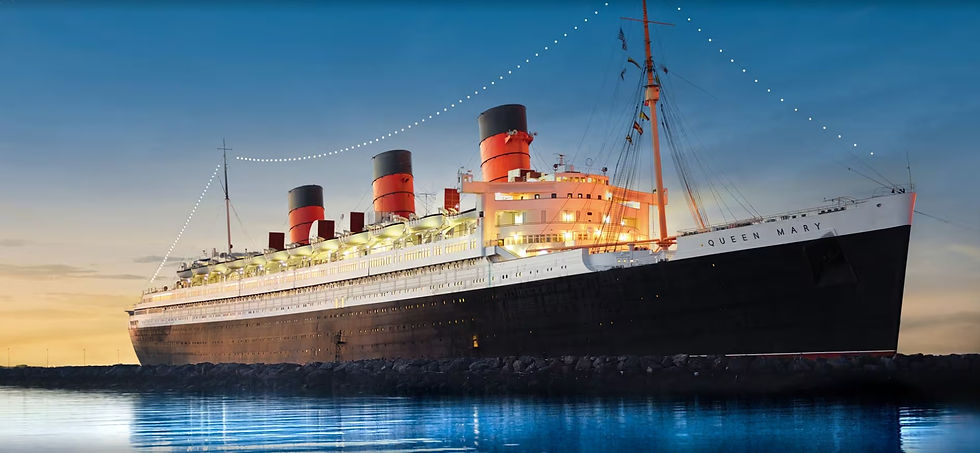
The Queen Mary Preservation and Olympic Readiness Project is an initiative led by the City of Long Beach to restore and revitalize the RMS Queen Mary, ensuring its long-term preservation while preparing it to support increased tourism for the 2028 Olympic Games. The project addresses structural deterioration, financial constraints, and management challenges while positioning the historic ocean liner as a key hospitality and cultural attraction during the global event.
The RMS Queen Mary, a British ocean liner permanently moored in Long Beach, has long been a significant tourist attraction. However, years of deferred maintenance led to severe structural issues, with a 2021 report warning of potential flooding or capsizing if urgent repairs were not addressed. The City of Long Beach reclaimed control of the ship after years of financial mismanagement by private operators. Despite allocating $23 million for emergency repairs, estimates suggest that up to $289 million is needed for long-term restoration. Additional funding challenges have slowed progress, but strategic partnerships, including a $12 million loan from the Port of Long Beach in 2023, have supported critical repairs.
Several urgent infrastructure and safety improvements have already been implemented. A 650 KVA emergency power generator was installed at the wharf to supply power to the ship’s emergency systems, including exit lights, elevators, and sewer pumps. The bilge pump system is now fully powered by the emergency generator, ensuring it operates independently of the ship’s main power. The system was rigorously tested by operating several bilge pumps on D-Deck, confirming its reliability in preventing potential flooding. Additionally, deteriorated lifeboats, which were stressing the ship’s structure, were removed to prevent further damage.
The next phase of the project focuses on preparing the Queen Mary to support Olympic tourism in 2028, leveraging its status as a historic landmark. The ship will play a key role in hosting international visitors, serving as a cultural and hospitality hub. Plans include expanding tourism and event spaces, enhancing public access and amenities, and developing hotel and dining upgrades to attract long-term tourism investment.
Despite financial and logistical challenges, the Queen Mary Preservation and Olympic Readiness Project is a major step toward securing the ship’s future while integrating it into Long Beach’s role in the 2028 Olympics. With continued investment, community engagement, and strategic partnerships, the Queen Mary will not only be preserved but revitalized as a premier destination for global visitors.
Outstanding Operations and Maintenance Project
Morris Dam Access Road and San Gabriel Dam Outlet Channel Rehabilitation Project
Los Angeles County Public Works
The Morris Dam Access Road and San Gabriel Dam Outlet Channel Rehabilitation Project is located in the Angeles National Forest, north of the city of Azusa, within Los Angeles County. Morris Dam, built in 1935, is a concrete gravity dam and San Gabriel Dam, constructed in 1939, is an earth and rockfill dam. They are operated by Los Angeles County Public Works to provide flood protection and water conservation for the downstream communities.
At Morris Dam, the Project improvements included removing over half a mile of existing damaged AC pavement at the lower access road and replacing with new AC pavement with concrete gutters; replacing rotting timber walkways and staircases of the west abutment drainage gallery with resilient fiberglass grating and structural members; remediating existing boat dock rails for access to the reservoir; improving lighting at the outlet structure and replacing worn facility doors and windows.
At San Gabriel Dam, the Project removed the deteriorated and failing invert armoring from the outlet channel and replaced it with a new high strength reinforced concrete armoring slab.
These improvements will provide safe and secure access to Morris Dam for routine maintenance, operations, and emergency response. The renovations at San Gabriel Dam will ensure the continued safe operation of the outlet works to provide critical flood protection and water conservation efforts.

Outstanding Parks and Recreation Project
Las Flores Park Aquatics Center Renovation
City of La Verne
The Las Flores Park Aquatics Center Renovation revitalized a long-standing recreational hub in La Verne, CA. Improvements included new pool decking, shade structures, energy-efficient lighting and filtration systems, ADA-compliant access, and modern pool equipment. The project was funded through a $1.5 million appropriation from Assemblymember Chris Holden, with additional financial support from the Bonita Unified School District and University of La Verne. Completed in June 2024, the project was delivered on time and within budget and now serves students, athletes, and the community under a joint-use agreement that maximizes its value and accessibility. The upgraded facility supports wellness, water safety, and recreational opportunities for all ages and abilities.

Outstanding Roadway and Highway Project
San Fernando Road Beautification Project Phase I
City of Glendale
The San Fernando Road Beautification Project includes construction of 17,900 square feet of center median islands, surface grinding and placement of 1.6 centerline miles of asphalt rubber hot mix, installation of 8,500 linear feet of new class II bicycle lane and class III bicycle route, modification of 12 intersections to meet current ADA standards and improve pedestrian safety, install drought-tolerant landscaping and stormwater filtration and infiltration systems, and installation of creative crosswalks and decorative fencing. The project created an aesthetic and safe multi-modal environment without sacrificing any traffic lanes.

Outstanding Small Project
Palmer Avenue and Green Street Rehabilitation Project
City of Glendale
The Palmer Avenue and Green Street Rehabilitation Project involved the surface grinding and placement of approximately 2 centerline miles of Asphalt Rubber Hot Mix (ARHM) pavement; surface grinding and placement of approximately 2 centerline miles of ARHM over Asphalt Rubber Aggregate Membrane (ARAM); selective removal, repair, and reconstruction of approximately 930 linear feet of damaged curbs and gutters, and 6,896 square feet of sidewalks, driveways, modification and reconstruction of approximately 10 existing curb ramps to meet ADA standards, and realignment of a critical neighborhood intersection, including the installation of creative crosswalks and a new stop sign.

Outstanding Sustainable Engineering Project
Permeable Alley Project
City of Glendale
The Permeable Alley Project rehabilitated over twenty alleys in western and southern Glendale neighborhoods by replacing traditional pavement with permeable surfaces designed to capture and treat stormwater runoff. To further enhance stormwater management, the project also included the installation of 12 infiltration wells and 7 bioswales near various alleys, maximizing water infiltration and reducing runoff.

Outstanding Transportation Project
Rosecrans/Marquardt Grade Separation
Biggs Cardosa Associates, Inc.
The Rosecrans/Marquardt Grade Separation improved safety and mobility at the intersection of Rosecrans Avenue, Marquardt Avenue, and the BNSF Railway tracks in the City of Santa Fe Springs, California. The tracks crossed the intersection at-grade and diagonally, with poor sightlines between drivers and railroad vehicles, and led to numerous accidents and fatalities. With more than 112 freight and passenger trains and 45,000 vehicles traversing the intersection daily, the California Public Utilities Commission deemed it the state’s most hazardous grade crossing. The grade separation project significantly improved public safety and emergency vehicle response times while reducing greenhouse gas emissions from idling vehicles.
As the prime consultant, Biggs Cardosa Associates (Biggs Cardosa) provided project management and structural engineering to the Los Angeles County Metropolitan Transportation Authority (LA Metro) and coordinated a team of subconsultants. Biggs Cardosa also helped with funding and supported LA Metro in obtaining a $15 million Transportation Investment Generating Economic Recovery (TIGER) grant from the U.S. Department of Transportation.
The design that Biggs Cardosa developed realigned Rosecrans Avenue to the south and designed an overpass above the railroad tracks at a 55.5-degree skew. The realignment reduced the number of properties that had to be acquired and minimized construction impacts. Employing spliced, long-span precast concrete girders achieved the necessary 227-foot span length along the high skew. Incorporating precast deck panels accelerated construction and reduced on-site formwork. Specifying a bent-type abutment design saved $1.2 million compared to traditional abutments. Extensive use of 3D visualizations helped property owners and the community understand the project’s impacts and benefits. Biggs Cardosa coordinated with numerous stakeholders, including local governments, BNSF Railway, utilities, and the California High-Speed Rail Authority to make this project a success.

Outstanding Urban or Land Development Project
The Cove at Century Villages at Cabrillo
Ardurra
The Cove development project is the latest development project within the Century Villages at Cabrillo campus that further densifies the campus while preserving a sense of home, security, and community. The overall $30 million project involved the demolition of the existing structures, the realignment of the existing street (Williams Street), realignment of the existing utilities within the street that will conflict with the proposed building footprint, and the construction of a four-story residential building consisting of primarily studio units. The existing structures required hazardous material abatement that was performed by others. This project was recognized as an important contribution to help support veterans that have been unhoused.

Outstanding Water Project
San Fernando Groundwater Basin Remediation (SRGBR) Program
Los Angeles Department of Water and Power
The San Fernando Groundwater Basin Remediation Program (SFGBR) is one of the most ambitious and impactful groundwater cleanup efforts in California and a flagship initiative of the Los Angeles Department of Water and Power (LADWP). This program comprises three major groundwater treatment facilities—North Hollywood West, North Hollywood Central, and Tujunga Central Treatment Facilities. These facilities are the first of their kind ever constructed by LADWP and are designed to treat groundwater contaminated with Volatile Organic Compounds (VOCs) and 1,4-Dioxane, restoring the basin’s beneficial use for long-term water storage and supply. Together, the facilities can produce up to 118,000 acre-feet per year (AFY) of clean drinking water—enough to serve over 400,000 Los Angeles homes annually—while reducing the City’s reliance on imported water and increasing resilience against drought and emergencies. The SFGBR Program earned Distinction as runner-up for Water Project of the Year at the 2024 Global Water Awards, recognizing its innovation, scale, and global relevance. This program represents a transformative investment in sustainable infrastructure and environmental restoration, advancing LADWP’s efforts to strengthen local water supply reliability and reduce dependence on imported water.

Outstanding Water/Wastewater Project
Distributed Drywell and Bioretention Installation Project
City of Glendale
The Distributed Drywall and Bioretention Installation Project successfully installed 14 drywells and approximately 400 square feet of bioretention for enhanced community stormwater management. This project will result in a more resilient and sustainable area within an urban landscape.


Comments